Recently a colleague shared with me a digital web archive of 3D restroom scans The Restroom Archive. As a fellow toilet academic archiving insights into toilets I was drawn to exploring these spaces as an artistic reference and humanistic inquiry and wanted to ask deeper questions than the larger publications have on this communal collection of toilets.
Follow the archive here: @restroomarchive
Follow Jake's work here: jakewelch.design
Steven: Hi Jake. Welcome to Toilet Game Studies. We cover all things virtual toilets here and The Restroom Archive encourages the masses to use photogrammetry, a technique to capture realistic 3D models for games and visual effects solely for the purpose of preserving toilets.
It's an incredible project and I am happy to have you here.
Jake Welch: First of all, so awesome to be reached out to by a fellow toilet enthusiast. I feel like it's the most strange niche thing in the world, and ever since I shared this project, it's been really fun to connect with people who are like, "No, we get it.
I am Jake Welch. I live in Brooklyn, New York. I'm originally from Salt Lake City, Utah. I am a designer and a creative technologist. I originally went to design school in Utah and then got more into programming, which is how I ended up into this niche field of creative technology.
Q: What is The Restroom Archive?
Steven: If you could give a elevator pitch of The Restroom Archive, how would you describe it in a sentence or two?
Jake Welch: It's an online archive of public restrooms. It was originally created just as a personal project, a personal way to showcase these restrooms that I was already scanning. But now it's become a full project of where I've attempted to mimic archives on the web used by libraries and museums to really document these spaces, give them their due, and encourage submissions and thoughts from people around the world.
Q: Why 3D scans?
Steven: Why photogrammetry scans? What was the first time you scanned a restroom? Why did you do it? What inspired you to start in the first place?
Jake Welch: It really started out as a joke. I was in design school, and one of the classes that I took was called Prototyping Methods, and that was just a class where we could learn all the different possible ways that you could prototype a project.
There was a lot of different aspects to that class. There was, like, mold-making creating paper models. But one of them was 3D printing, and everybody in my class was trying to find different ways that we could bring products that we were prototyping into 3D so that we could iterate on them further.
And I started to discover photogrammetry and Polycam. We were using that to scan objects around the classroom but one night I went out with friends, and we were at IHOP at 2:00 AM and I started to scan the restaurant just as a joke.
I was just scanning our table, and 3D scanning apps get super crazy and out of whack, layers shift, it was really cool to be able to see everybody's faces from different angles, that started off my interest in wanting to use this app to scan spaces.
A few months later, me and my wife we were driving from Utah to California to visit family, and along the way I started to scan the restrooms at truck stops. And the first one was fine. It was just like a regular gas station restroom. But the next one that we hit in Barstow, California had this outdoor trash can that they had dragged inside and wedged between the toilet and the urinal, and it was just so stupid and so funny that I was like, "Oh my God," there's actually something interesting about this.
What other spaces do we use and do we create where they're so haphazardly thrown together, the people that maintain them think "Everybody that's gonna use this space is gonna be in and out in the next 10 minutes, and they're gonna forget about it."
I found that really interesting, and my design brain kind of started to tick. I want to build a collection of these restrooms, because I felt like every one that I was hitting was totally different and interesting in its own way.
The, the collection followed the medium, if that makes sense.
Q: What's the difference between this archive and other toilet collections?
Steven: How would you describe the main difference between The Restroom Archive and the really useful New York Restroom Map? nyrestroom.com
Both are maps of toilets but they track different information. How would you describe the main differences there?
Jake Welch: Yeah. I guess the toilet map is very much a utility map. I haven't even used it. And I have a lot of people suggest adding these types of things to The Restroom Archive.
But the, The Toilet Map is mostly so people can use it to find restrooms. Everybody who's been to New York knows that there's no public restrooms hardly, u- until now, 'cause Mondani just announced there's 17 new restrooms being added to the city which is a huge deal. Probably sounds funny to people who are from other big, developed cities.
But The Restroom Archive is solely to document. I want it to be a place where people can think about the spaces that they're using. Like I mentioned before, by their nature they're not considered. They're thrown together and totally utilitarian. And I think that's interesting, and I think that's worth documenting
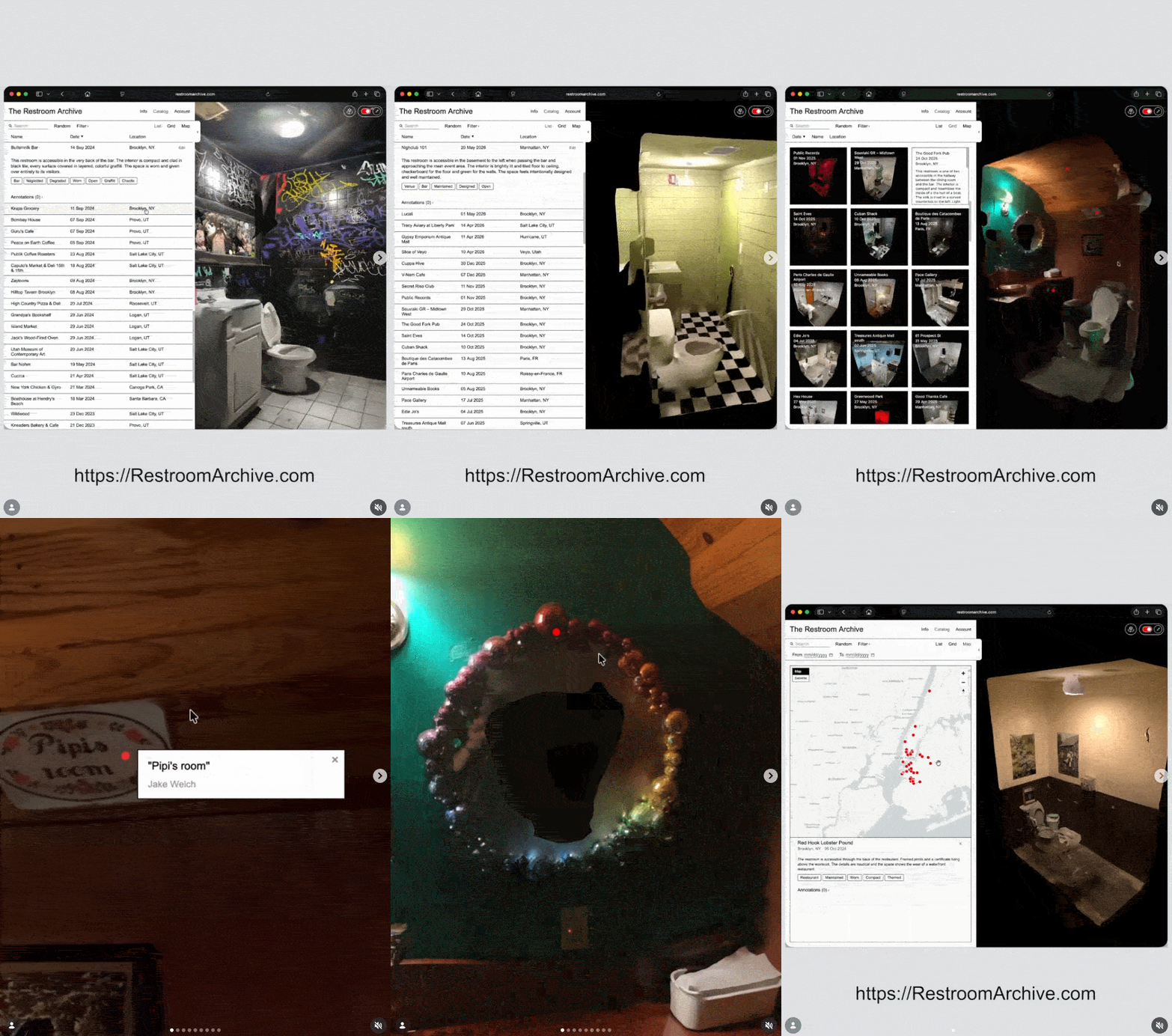
Figure 1: Overview gif of restroom archive in use
Q: Do restrooms have a culture?
Steven: So is there any particular New York toilet culture? You mentioned how there's very little public restrooms, and it's maybe even akin to urine town where it's really hard to find a place to pee or- access that. But, do you think cities have particular, like, reoccurring motifs or themes within their bathrooms?
Could you potentially even see in the future, once the Restroom Archive is more established, even competitive geo-guessers being able to tell where a toilet is based off of solely the interior? And do you believe your site will eventually be able to unearth, untold truths about the human condition by close study of the restrooms?
Jake Welch: Absolutely. I think the interesting thing about restrooms is that they are a reflection of the personality that they're existing in or the establishment that they're existing in.
For example, you go to a bar restroom, they're always completely covered in graffiti. They're missing mirrors. They're gross because the people using them are drunk and, have poor aim. They're very much a reflection of the place that they are.
And I've thought about this too, like the difference between restrooms I've archived in the city versus the suburbs. Suburb restrooms are always massive. They're huge and it reflects the urban sprawl car culture. But in the city, you'll see a lot of restrooms in my archive with slanted ceilings because they're literally shoved in a cupboard under the stairs. Space is so limited here in New York that they have to be a lot more creative with where they put these restrooms. Other things you'll find is a lot more storage being in restrooms. Space is tight, so that might mean adding shelves up high where they can really just shove things in every possible negative space.
To the geo-guesser point, we've already been getting some submissions from other countries, and it's been really fun to see bars in Germany for example, there's still graffiti, but they're still somehow really clean and really usable. I think that's also reflecting of European culture versus culture here in the US.
People have been finding restrooms that I would've never stumbled upon that I think have something valuable to bring
Q: Will you release the restroom files?
Steven: So a lot of websites that have a lot of data sometimes end up publishing, like, yearly reports about the data they collect. For transparency, but also curiosity.
Their metrics, of course, or the analytics. And I'm curious if you ever have any plans to publish that sort of information, 'cause it is being tagged and collected. Maybe generalizations across the board like, restrooms in this particular area have a lot of these tags, whereas to restrooms in this particular area don't.
Would you publish those anomalies?
Jake Welch: That's actually a really cool idea, yeah. 'Cause, pretty much all of the data that I'm collecting is available for everybody to see, but I'm always looking for different ways to draw correlations and to create collections of the restrooms that I'm archiving. I'll definitely consider that.
Q: How do you categorize restrooms?
Steven: I am kinda curious about, How you ended up arriving at those filterable tags.
You have 46 different filterable tags on the site currently. Yeah ... did you categorize the restrooms that way depending on designing the site initially? Or was it something that evolved over time? Did you add tags as you, updated the site over different iterations? Do you believe that there are missing or unexplored types of restrooms that you have yet to come across that deserve a new tag?
Jake Welch: Mm-hmm. So this is all part of my 2.0 version of the website. Initially it was just just the models themselves, location, name, and the coordinates. I didn't even have a map function or anything like that. But in about April of this year I was trying to think that when you can filter and sort things in an effective way, you can really start to create these collections and start to draw correlations. For example, one of the filter tags that I have is red light. That was because I was noticing that a lot of restrooms, especially in bars, had red lighting. It's fun to compare them.
When I was prototyping and working on the website, I went through a lot of different types of ways of creating the tags, the initial tags, because anybody can add their own tag if they want to.
I tried to be really exhaustive. I tried to consider the atmosphere of the space, the type of establishment, the condition, whether there was any human traces like graffiti or if anything was out of order. I just tried to think of any sort of category that I could build those around.
And even now I feel like I'm adding new ones. Like maybe a week ago I added the mirror-free tag just because... I noticed on one of my archives, somebody left an annotation that the restroom felt unsettling because there was no mirror. I'm always looking for new ones to add.
Q: Where do you draw the line?
Steven: Do you plan on expanding the archive to include ambient background noise recordings to fully immerse the user in the experience of using the restroom, of being there?
Or is that too far in terms of invading privacy, you think? You mentioned in the About section of the site that there is, no better space in society where people know nobody else is watching.
Jake Welch: Mm-hmm.
Steven: In an information age of mass surveillance and AI, do you believe the restroom to be the last bastion of privacy? And would audio recordings taint that a little bit or invade that?
Jake Welch: Yeah, I don't think I would add recordings, especially just because I feel like 99% of the sounds that you're gonna hear in a restroom are not pleasant ones, and I don't wanna have to vet that and have to listen to that.
I think I can still fill that void using the descriptors in the descriptions. For example, somebody just added a restroom at BK Tacos here in Brooklyn, where in the description they said a, a robot voice says, "Locked" once the door is locked. So they were able to describe a noteworthy sound in the description without having to record it.
I think you make a very obvious important point with privacy, and that's a main concern of mine. Part of the submission rules is that it has to be in a public but single-use restroom. And that's because I don't want people recording where there's other people doing personal private things. I don't want people recording private spaces that belong to somebody's home.
Steven: Do you notify the owners personally before scanning their toilet or is it considered fair use 'cause it is a semi-public space? And does this apply for places where you need a pass code to access the restroom based off of ordering something at that establishment?
Jake Welch: I've never notified anybody. I've considered the pass code thing. I don't know if I should encourage it or not, but I like the idea of pass code being left in the description for people to use. I do think there's some anti-homeless attitude when you have pass codes on your door. Restrooms are already so restricted in a way to people. They're not available. So I don't know. It's something to consider.
Steven: And on that note if an owner with an establishment who has a scanned toilet of their establishment requested a removal, would you simply comply with that request - take it down?
Or do you believe that restrooms deserve to be publicly available knowledge for the betterment of the general public in a open source punk fashion?
Jake Welch: Honestly, I would remove it if they requested it, just because i'm not here to cause any problems. This is just a project that started out of pure fun and interest. People are welcome to request it. But if they want it removed because the condition of their restroom was bad, that is kind of on them to a point. So maybe, I could push back while still complying, and to that point, I also have been considering for a future feature adding versioning of restrooms. What if you go back to a restroom and it's completely changed? I've had multiple cases like that where the design is totally different. Maybe that would encourage owners to maintain their restroom better and get a better scan uploaded to show the improvement of the conditions of their restroom,
Q: How do you maintain the archive?
Steven: How long do you see yourself maintaining this project, this archive?
Have you considered getting community members, not just as submissions help, but also as moderators for approvals or any other assistance to keep the site running both financially but also maintaining it in perpetuity?
Jake Welch: I intend to keep doing it as long as I feel interested in it.
I think I've been at it for three years, and my interest has only increased. I do have it already built out to have other admins if I ever need help. I do have one other admin who's a close friend of mine, but he's pretty checked out. He doesn't even really look at it. But yeah, if this grows to the point where I do need extra help, I would be happy to bring other people on.
Q: What is the personal value of toilets for you?
Steven: Would you consider toilets and restrooms in general a special interest of yours? Or is it more of a means to an end? And if so, what end? What personal value proposition- is it to you to keep this collection of restroom models alive? Is it just a portfolio piece or is it an icebreaker, or is it something more? Why are you doing this, especially when it probably costs you at least 14 bucks a year- on the domain.
Jake Welch: Yeah. It doesn't cost me almost anything, and I designed it that way.
It started out as a means to an end. It started out as just a fun project to learn web development. Then it became a portfolio piece. But now after three years, it's definitely grown into a personal interest.
I definitely think a lot about restrooms, more than the average person. I walk into an establishment... Like the other day we were in Connecticut, me and my wife, and we went to an antique store. I immediately sought out the restroom, 'cause they're usually kinda, kinda weird in antique stores. I was not disappointed.
It has definitely become an obsession of mine.
Steven: There's definitely worse things to be obsessed about and I think toilets is-
Jake Welch: Debatable ...
Steven: is a great choice.
Q: What's the most interesting thing you've learned in your time with toilets?
Steven: In your time with Toilets, what is the most interesting thing you've learned?
Jake Welch: I feel like it's just made me more observant of... the different ways that these spaces are treated depending on where you are. Like, toilets are very geographical. How they're talked about, how they're named, how they're treated in different cultures, and it changes every time a new restroom is added from somewhere else.
I gain new insight on the world,
Steven: Would you say, toilets are a door into ethnographic research.
Jake Welch: Absolutely. I don't know, de- depending on where you are they might be cleaned a little bit better or depending on where you are there's gonna be different graffiti left inside.
Even the toilets themselves reveals so much, more than we think.
Steven: Are there any thoughts you really wish to share with the public on restrooms?
Jake Welch: Specifically, this archive that I've created about toilets, don't write it off because it's a taboo topic or because it seems weird or strange. There's an anthropological value to archiving and analyzing these spaces.
These spaces there's something about them that's really unique in that they have so many visitors in such a short amount of time, and each one of those visitors isn't paying very much attention to it. It builds up these layers of humanity. I think that they are very much a reflection of human nature whether on how it's decorated, whether and how it's used, how how it's maintained, and how it's designed.
I think it reflects the good and bad parts of humanity.
Anybody who comes across this website, I want them to consider contributing, just because the more points of view that we can gather on the archive, the more interesting it is for everybody who cares about this topic.